
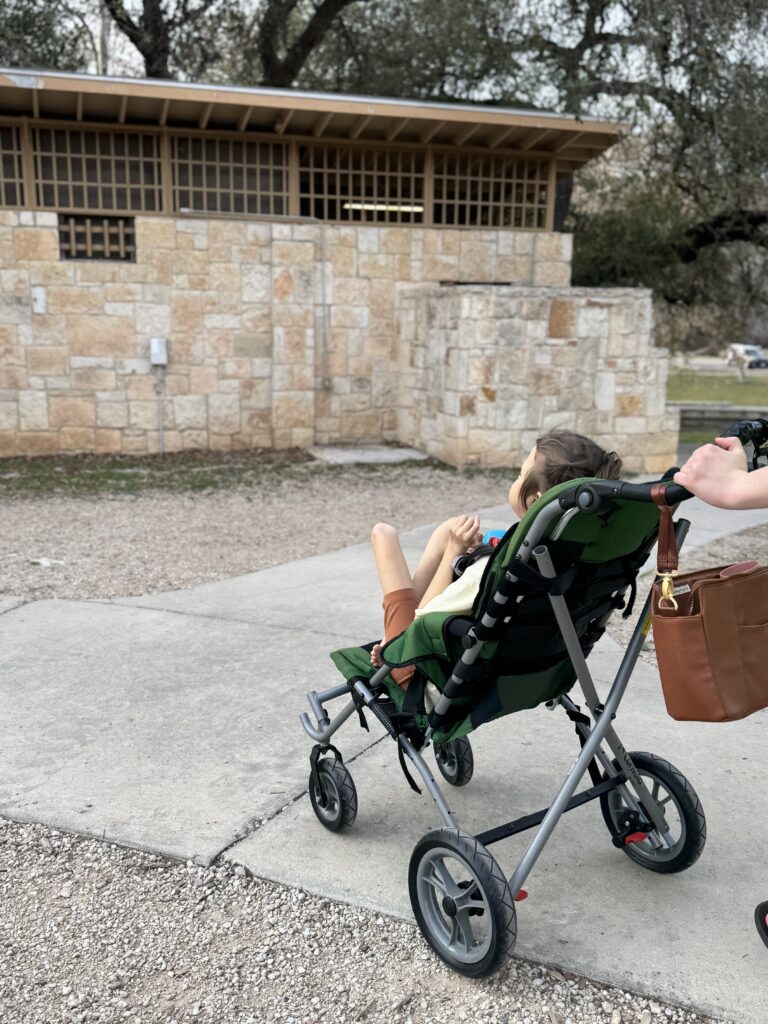
There’s a strange gap that happens when your child outgrows mainstream strollers but still needs full mobility support. And the next step isn’t sitting on a shelf at Target.
All at once, the stroller’s seat is too narrow. The length too short. The support not quite enough. You’re pushing something that clearly wasn’t designed for this stage of life.
For families with disabled children, that moment hits differently. Because you’re not just losing convenience — you’re losing mobility. Many families eventually start searching for a medical stroller for bigger kids when traditional strollers no longer work. It took my family years to learn about this option. My hope is that you walk away with the information I wish I had when I first started this process.
I remember sitting there thinking — what am I supposed to do when my child is bigger but still needs mobility support? When carrying them long distances isn’t realistic anymore, but everything easily available in stores, doesn’t work either.
That’s when the trial and error phase really began. It led us to both prescription medical equipment and heavy-duty wagons.
Our insurance-approved stroller solved major problems for us, but it didn’t solve everything.
Everyday life still required flexibility: trips to the beach, road trips across the country, cheering on siblings at sports games, walking through the park , even weekly grocery runs.
Over time, we’ve found ourselves using both a medical stroller and a heavy-duty wagon. Not interchangeably — but intentionally. Each one solved different problems.
Quick guide
- Medical strollers provide postural support and positioning
- Wagon strollers offer flexibility for everyday outings
- Many families end up using both depending on the situation
If you’re navigating mobility options for a bigger disabled child, here’s what has actually worked for us — and when.
What is a medical stroller (and why we eventually needed one)
Medical strollers are different from traditional strollers. They’re designed for children who need additional positioning, support, or mobility assistance. Many are prescribed through insurance and are considered durable medical equipment (DME).
Before getting the Convaid Cruiser, we had already learned the hard way that not all mobility equipment is created equal.
Years ago, we were approved for a tilt-in-space wheelchair. At the time, we didn’t know the right questions to ask our DME provider. Insurance approved it, it sounded supportive, and we trusted the recommendation in front of us.
We tried to use it in everyday life. Between loading it into the car, setting it up in parking lots and maneuvering it for simple outings — we realized it was far more equipment than we actually needed.
Insurance locked us into that decision for five years.
So we adapted.
How we ended up using both wagons and a medical stroller
One of the first things I tried was a utility wagon from Academy. The ones you usually pull your sports equipment in to the field. It was around $49 and had a pull handle. At first I was excited thinking I had found a great solution.
That didn’t last long. Trying to pull a wagon behind me with a child inside, where the weight was constantly shifting, was not ideal. It showed me one important thing, however. I needed something that could be pushed, not pulled.
Wagons with a push style design are significantly easier for heavier children because you can maintain better control of the weight.
Our first working solution : The Keenz Wagon
I went down the rabbit hole of wagon research. Weight limits, harness strap options, portability, push vs pull design, wagon depth and pricing. The first wagon I found that was in our budget was the Keenz Stroller.
It’s worth noting that Keenz has redesigned in recent years, and newer versions are now much more similar to heavier duty stroller wagons like the Wonderfold. The model we used at the time was one of the earlier versions and had a lighter build a fewer features.
The biggest deciding factor in choosing a wagon style stroller for us ended up being that lesson I learned earlier with the red wagon: push vs pull.
At the time, most wagons were designed to be pulled behind you. I knew that I wanted a wagon style stroller, but pulling it just wouldn’t work for us. I needed something I could push, especially as my daughter grew and got heavier. The keenz was one of the few options in my budget that offered that, so that’s where we started. We used this wagon for 1-2 years.
This was the perfect starting wagon. It gave us flexibility, space, and a more practical option for outings. But as she grew, new safety concerns showed up.
Due to the Keenz shorter side walls, she was able to lean over the sides as well as reach the wheels while sitting inside the wagon. The previous design also did not have detachable seats, so the harness was attached to the inside of the Keenz itself, keeping the children low and closer to the wheels. For us, this meant more exposure to germs and potential injury.
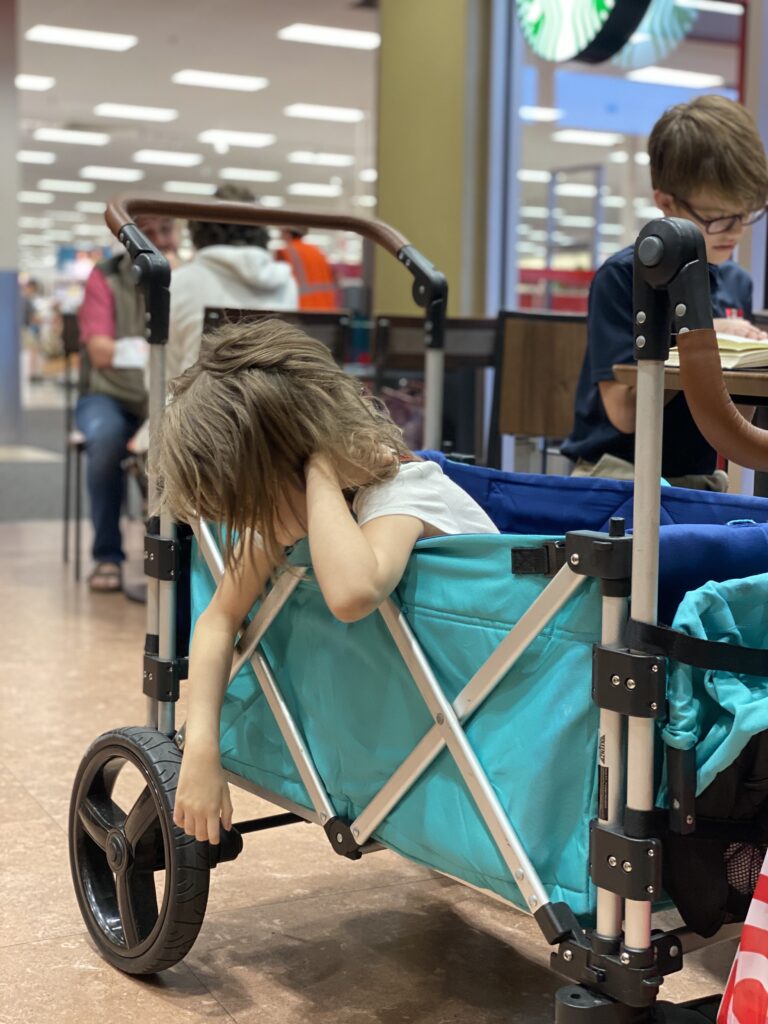
We still didn’t have the ability to purchase a medical pushchair out of pocket, so we transitioned to the Wonderfold Wagon.
It was a natural next step as the designs were similar. It handled her size better and felt more stable. I wasn’t constantly watching her hands or worrying about the wheels. For long days out it gave us the space and flexibility we needed. We loved it and we still use it often.
Finally, our insurance cycle reset.
Now that we were eligible again, we were far more informed. This time, we were specific about what she actually needed: supportive, yes — but practical for daily life. Foldable. Manageable. Structured support — but not something so bulky that it limited our everyday life.
We worked with a new DME provider who suggested the Convaid Cruiser medical stroller based on my daughter’s needs. After testing it on site, we agreed it was a good fit for us .
A medical stroller — or medical pushchair — is considered durable medical equipment (DME). It’s prescribed when a child requires postural support, positioning, or mobility assistance beyond what retail products can safely provide. Unlike standard wagons or strollers, these are built for structured support first.
Approval wasn’t immediate. After an initial denial, we filed an appeal with documentation from me, her doctor and our DME provider. Thankfully it was overturned. We have been incredibly grateful for the stroller.
Our experience with the convaid cruiser
The Convaid Cruiser is considered a medical wheelchair by insurance. It can be prescribed by your provider and is covered by most insurances, however, be aware that most insurances will only cover ONE wheelchair in a given timeframe. So consider that when choosing what style of wheelchair best suits your childs FULL needs. It is typically best to have insurance cover the most expensive option you are allowed, in the event you need to pay out of pocket for another style of chair before the time frame has expired.
The convaid cruiser stroller works great for us and unlike the tilt-in-space wheelchair we once had, it’s practical.
For us, it works especially well for quick trips — the grocery store, short errands, appointments. It folds almost flat in an umbrella-style design and fits in the car far more easily than larger equipment. Setup is fast. No long parking lot assembly.
More importantly, she’s comfortable in it.
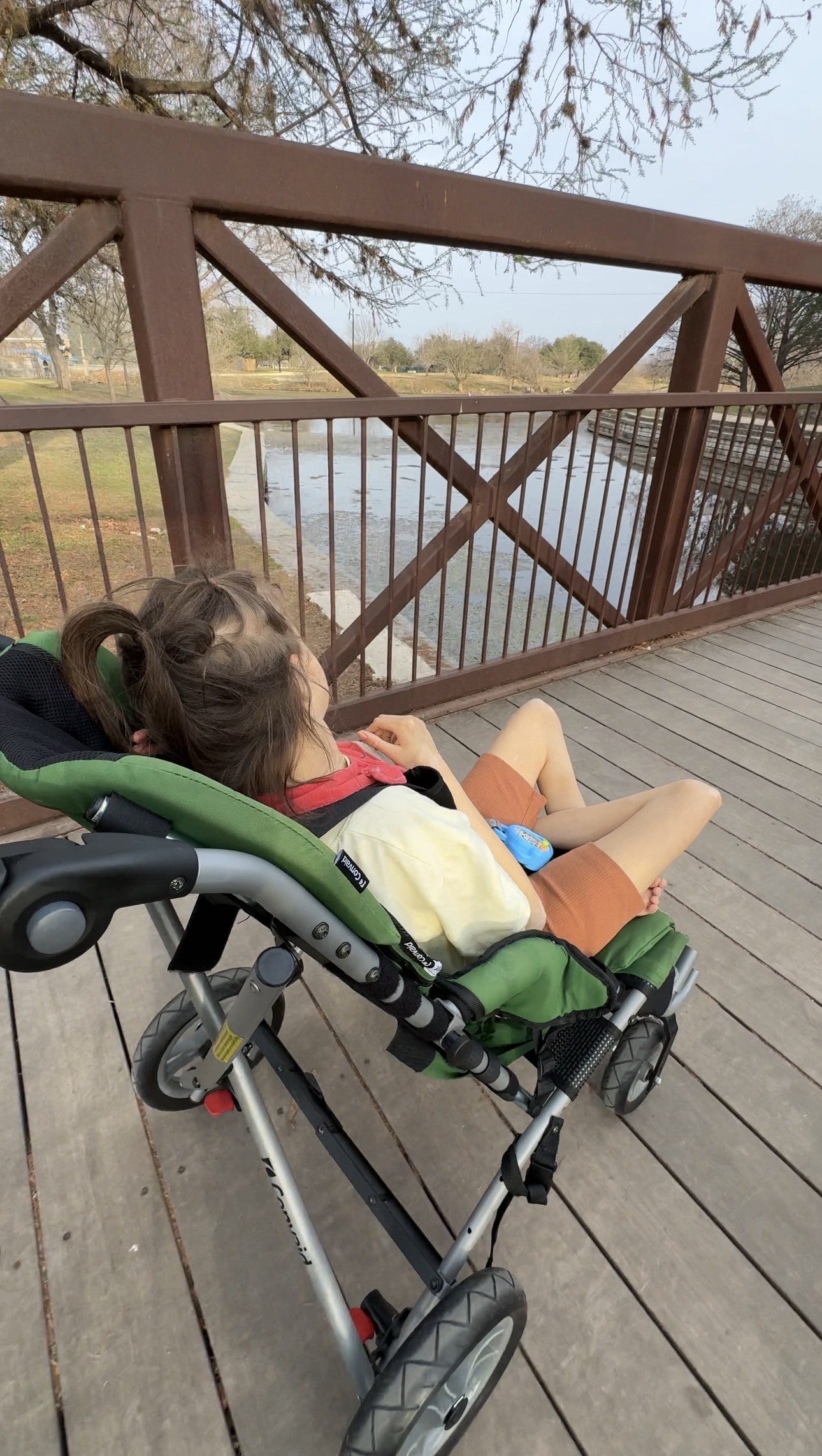
The seating position offers support without restricting movement. She can sit upright and secure, but still move her arms and feet freely for sensory input. We can easily strap a toy or bottle to it. It feels supportive without feeling confining.
That balance matters.
The Convaid gives her body the positioning it needs — but still allows her to be active and engaged.
Our experience with the wonderfold wagon
The Convaid works great for certain situations. The wonderfold works beautifully for others.
They don’t replace each other , they serve different purposes.
The Convaid is lightweight and easier to take in tight spaces, but it doesn’t create a covered environment the way the wagon does.
When we’re heading to sibling sports games, doctor offices, or a friend’s house, we often choose the Wonderfold instead.

There are a few reasons for that.
First — the carriage design.
In the wagon, she’s less likely to reach out and touch everything we pass. In busy environments, especially during cold and flu season. It’s not foolproof but it lowers the risk of germs.
Second — weather protection.
On windy or cold days, the wagon creates more of a protected space. It feels like a cocoon. She can sit surrounded by her comfort items instead of fully exposed.
Third — endurance.
The seats that come with the stroller are removable and allow her to lay down inside, if she’s tired, needs to snack, or wants to drink a bottle , the wagon gives us more flexibility. She can stretch out a bit. We can bring extra blankets and carry medical/diaper bags easily.
That’s where the Wonderfold has remained incredibly valuable for our family.
When we choose the wonderfold instead
There are days when convenience isn’t the priority — having an enclosed ,comfortable space is.
One unexpected advantage over traditional strollers that I cannot overstate: I can change her diaper in it.
When the wagons side wind panels are in the down position ,she has privacy. Even in a bathroom without an adult changing station or a large stall, I can pull the canopy top down and lean in to change her. It gives us flexibility in public spaces that aren’t designed for children her size.
In our everyday life, she’s safe and comfortable inside. I’m not constantly watching to make sure her arm doesn’t get caught on a shelf in a store. I’m not redirecting her hands every few seconds because she’s grabbing items as we walk by.
It gives me breathing room. Not because it’s perfect. But because it reduces the mental load.
That’s why we still use it — even now that we have a medical stroller.
The wonderfold is not a medical stroller, and it doesn’t provide medical-level positioning. But for our everyday life, it fills practical gaps that a prescription chair simply doesn’t.
Wonderfold has been such a help in our family. Its worth mentioning that the company also has a program that offers a discount for families with medical needs.
Important: Wonderfold’s Special Needs Discount program
Wonderfold offers a Special Needs Program that provides a 25% discount for families with a licensed medical provider’s verification. The process requires an application and documentation from a healthcare professional confirming that the wagon provides tangible benefit.
You can find the Special Needs Program application directly on Wonderfold’s website.
Wagon vs Medical stroller: Quick comparison
The convaid cruiser is one of many push chairs/ medical strollers on the market. It’s the model our family currently uses. There are other brands and styles of medical push chairs to consider as well. The cruiser is a lightweight medical stroller designed for children who still need positioning support but still want something practical for everyday outings.
Type: Medical Stroller/Pushchair.
Typical Weight capacity: Up to 250lbs.
Harness: Customizable to your needs.
Standard features:
- 30 degree fixed tilt seat angle
- One-piece push handle
- Foot operated rear wheel locks
- 2 point positioning belt
- Removable, swing awing away footplates
- Adjustable seat-to-back angles
Extensive OPTIONAL features available
Fold: Umbrella fold for transport.
Stroller weight: Typically between 27-32 pounds
Insurance coverage: Often covered as durable medical equipment (DME).
Price range: Base price around $1886.
Website: Available on multiple sites including especialneeds.com & adaptivemall.com
The Wonderfold is a heavy duty stroller wagon designed for families who need space, flexibility, more seating and higher weight limits than traditional strollers provide. While it’s not a medical stroller, many families with disabled children use wagon style strollers for longer outings and when postural support is not the primary need.
For us, the wagon became the better option for long park days, medical appointments , travel days or outings where we needed space for medial bags, snacks and comfort items.
Type: Stroller Wagon
Wagon-style strollers have become a popular alternative for families whose children have outgrown traditional strollers but still need mobility support.
Typical Weight capacity: Up to 300 lbs.
Each seat is rated up to 99 lbs which makes it one of the higher capacity stroller wagons available.
Harness: 5 point harness
Standard features:
- 2 removable seat benches with 2 harness each, for up to 4 children
- Bench seat weight limit up to 99 lbs each
- Forward or Backward facing reversible bench seats
- Deep well-ventilated carriage with roll-out wind/privacy shade
- One-piece adjustable push handle
- Foot operated rear wheel lock
- Large removable canopy for UV 50+ protection
- Extra storage pockets on sides, rear and front
OPTIONAL accessories available
Fold: Collapsible flat fold for transport.
Wagon weight: Approximately 51 pounds depending on accessories
Insurance coverage: Not typically covered as durable medical equipment (DME).
Price range: Typically between $600-$900 depending on model and accessories.
Wonderfold has a program that offers a discount to medical families. See website for requirements.
Website: Available on Wonderfold’s website
Questions people ask when they see our wagon or medical stroller
These are some of the questions parents often ask me about when discussing strollers, wagons and wheelchairs for bigger disabled kids.
What stroller can hold a bigger disabled child?
Medical strollers-sometimes called “medical push chairs” are designed specifically for this stage. They provide higher weight capacities, deeper seats and additional support for children who still need mobility assistance.
Some families also use heavy-duty wagons for certain outings because they can provide space, containment and more flexibility for longer days out. In our experience, we’ve found that using both a wagon and a medical stroller works best for our needs and we use them equally.
Are medical strollers covered by insurance?
Sometimes. Medical strollers are considered durable medical equipment (DME) and may be covered when prescribed by a doctor and approved by insurance. Approval often requires documentation and sometimes an appeal.
Why not just use a regular stroller for a bigger disabled child?
Standard strollers are designed for toddlers and smaller children. As disabled children grow, they often need a higher weight capacity, seat depth and postural support than regular strollers provide.
Why do some families choose a wagon instead of a wheelchair or medical stroller?
A wagon can work great for everyday life- long park days, sports games, road trips or errands. It creates more contained space, has room to hang medical bags or comfortable items and can be customizable.
For some families, the wagon fills the gap between a traditional stroller and prescription medical equipment .
In addition, the wagon can be the most accessible option for parents as they dont require a prescription and are a fraction of the cost of a wheelchair or push chair. Wonderfold specifically offers a discount to special needs families. (Check their website for current requirements)
This isn’t medical advice- just lived experience from a family learning in real time.