
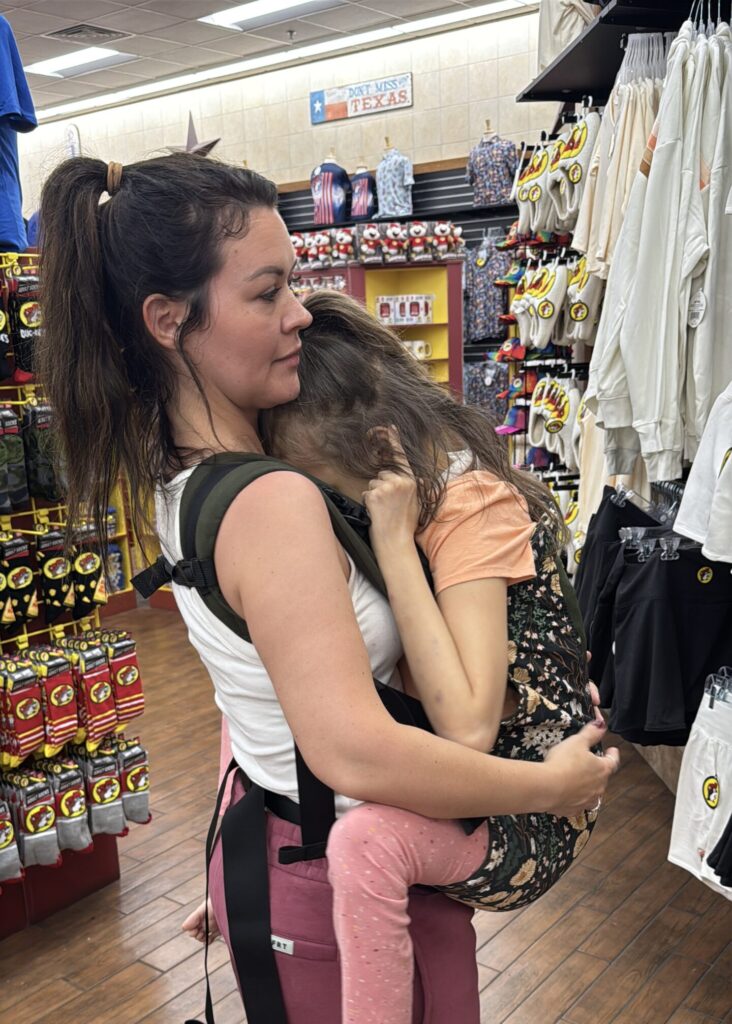
I’ll never forget the conversation I had one afternoon at my friend’s house. We got talking about the different baby carriers she had, the brands she’d tried, and which ones she liked. At one point she mentioned that some brands started making them in bigger sizes.
I don’t think she realized just how life changing that statement would be for my family when she said it.
My daughter has sensory sensitivities that make holding her difficult. She doesn’t tolerate an arm on her back or under her knees. At that time she was around 45 pounds, and carrying her into a store, standing in a line, walking any distance was not easy. My husband and I were switching her back and forth just to manage it.
That afternoon I went home and started looking into baby carriers for bigger kids, specifically the carrier brand she mentioned. It was one of those moments where your whole mindset shifts and you realize a solution existed that you never knew was there. I’ve never forgotten that conversation.
Why Babywearing Still Works for Older Kids
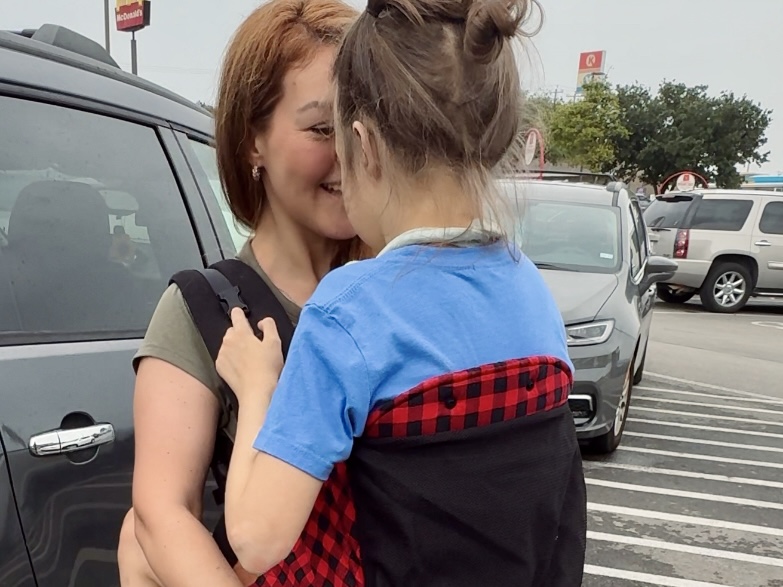
When you’re a parent to a disabled child or teen, there are moments when their wheelchair or stroller isn’t the easiest option. Sometimes it is easier and safer to use a baby or child carrier.
I have an older child whose school has no wheelchair ramp and 4-inch drop offs at every doorway. It is incredibly difficult trying to maneuver a wheelchair in and out of a small office and into each door just for signing them in and out for lunches and appointments.
I remember when my daughter was eight, we did a 2-mile guided underground cave tour using the Kinderpack Preschool carrier.
It was one of the few, full family experiences we’d been able to have in years. That is not something a stroller or wheelchair could have handled.

Now that my daughter is older, I use our carrier the most for the kind of errand that is just a quick in and out trip. Dropping off a forgotten lunchbox, going into the post office, gas station or walking up and down stairs.
Mobility needs don’t go away as a child gets older, if anything they can become more difficult to navigate.
For my daughter’s needs, a carrier was a mobility tool worth investing in, and for us it has made situations and environments safer to move through.
What Carrying a Bigger Kid Actually Feels Like
People want to know if it’s hard on your body or whether it’s even possible past a certain weight. It doesn’t feel that different from one size to the next, as long as you size up with them.
I’ve gotten a bigger carrier every time she needed it, and each change felt gradual. The weight grows with them, and the right carrier distributes it so that what you feel is just heaviness, not strain.
The best way I can describe it is a piggyback ride. You’re going to feel your child’s weight, but you shouldn’t feel it pinching your lower back or pulling on your hips.
When the fit is off, the weight doesn’t distribute evenly and your body compensates by letting the stronger muscle groups take over instead of the ones that should be doing the work.
It’s similar to doing a lat pulldown at the gym and feeling it in your biceps instead of your back. A carrier that fits right puts the weight where it belongs
Tip: If you’re feeling the weight it in your hips or lower back, check your fit. Tighten the waistband, adjust the shoulder straps, and make sure the carrier is sitting at your natural waist.
I can wear her for about 20-30 minutes before I need a break. After that I’ll swap with my husband, put her in the stroller, or wheelchair. If she needs to be held again later, I’ll put her back on.
There have been days where I got the carrier out and realized I was too tired to do it safely, and I put her back in the stroller. Knowing your own limit on a given day is part of using the carrier safely.
Start With Panel Height, Not Weight Limit
When I first started looking at carriers for a bigger kid, I only looked at the weight limit. I bought a toddler-size carrier, assumed she would fit, and I was wrong.
The panel was nearly halfway down her back. She was pushing against me and leaning further back than she should have been able to.
The back portion of the carrier where the fabric runs from the waistband up along your child’s back is called the panel. That measurement is the first number to look at, before anything else on the product description.
When it’s the right size, it comes up to just under their armpits at minimum, or to the base of their neck for a better fit on younger kids. When the panel is too short , your child will be able to arch backwards or hang sideways out of the carrier.
How to Figure Out What Size You Need
Every brand names their sizes differently. What one company calls Toddler, another calls Child. A Preschool size might overlap with another brand’s Toddler range.
When you’re shopping across sites, the size name alone won’t tell you much. What you need is your child’s actual measurement.
The carrier’s panel is measured from the top of the waistband seam to the top of the panel. So you’ll need to measure from just under your child’s bottom (where the waistband would sit) up to their armpit.
That number is your minimum panel height. Any carrier with a panel shorter than that measurement will not fit your child correctly, regardless of what the weight limit says.
Once you have that measurement, you can look for carriers with the right panel height.
If your child’s panel measurement puts them in one size, but their weight puts them over that size’s limit. I suggest going to the next size up. The panel will be slightly taller than your measurement, but for an older child with full head control, it’s safer than trying to carry over the weight limit.
Don’t Forget Your Own Measurements
One more thing worth checking before you buy is the waistband fit. Most carriers list a waistband range in the specs, typically something like 26 to 60 inches. If you’re outside that range, some brands sell waistband extenders separately.
Kinderpack offers both standard and plus sizing on their carriers, which changes the shoulder strap length as well as the waistband. Check your own measurements against the carrier specs the same way you check your child’s panel measurement.
Carriers that work for bigger kids and teens
The Tula Preschool Carrier was a popular carrier. It’s not in the table because it has been discontinued. I reached out to Tula directly and they confirmed it’s no longer available. You may be able to find it in Facebook groups for buy/sell/trade.
Here’s what’s available at different weight and panel ranges. I’ve included carriers I’ve used personally along with some more well known brands.
| Carrier | Weight Limit | Panel Height | Best For |
| Kinderpack MAX | 55-95 lbs | *note | Highest weight capacity/Tallest Panel |
| Kinderpack Child | 45-85 lbs | 22 inches +2 inch headrest | Bigger Kids needing full back support |
| Kinderpack Preschool | 35-55 lbs | 20 inches +2 inch headrest | Preschool sizing |
| Tula Toddler | 25-60lbs | 17.5 Inches | Strong waistband, widely available |
| Lillebaby Carry On Airflow | 25-65 lbs | 19 Inches | Widely available, ergonomic |
| Hope & Plum Lark Kid | 25-65 lbs | 20.5 Inches | Beautiful fabrics, ergonomic |
| Lenny Lamb Preschool | Max weight 66lbs | Adjustable 15-20 Inches | Adjustable panel for growing kids |
| Didymos DidyKlick Toddler | 44-55 lbs | 19-20 Inches | Half-buckle carrier with wrap-style comfort |
* Kinderpack does not publish the panel dimensions for the MAX size. I have one and measured it at 25 inches + 2 more inches with headrest. -> Visit the Kinderpack website to check current pricing and sizing options of their baby carriers for bigger kids.
NOTE: Kinderpack MAX is only sold as a custom order or preorder directly through the Kinderpack website, so plan ahead if that’s the size you need. Kinderpack also notes that caregivers should be at least 5’4″ to carry a child in the MAX size comfortably.
Quick Pick Guide
- Need the highest weight capacity, longest panel height and most long term flexibility? -> Kinderpack Max
- Need a structured carrier with beautiful designs for weights less than 60lbs? ->Tula Toddler or Hope & Plum Lark Kid
- Want a carrier you can easily order on Amazon or Online at Target? -> Lillebaby CarryOn Airflow
- Planning on using the carrier outdoors or in a hot climate? -> Look for a carrier with a mesh panel
- Does your child have sensory sensitivities ? -> Brushed canvas like Kinderpack tends to feel softer against skin than mesh
Prices range from around $75 on the lower end to $200 and up for Kinderpack. If that’s out of budget right now, I’ve purchased a handful of used carriers from Facebook buy/sell/trade groups and would recommend looking into that option. Especially if you are unsure if your child will tolerate a carrier.
Watch: Baby carriers for bigger kids compared in real life
What We Use Now
We use the Kinderpack Max carrier. We went through the Preschool size first, and as she got taller the panel got shorter on her back, so we sized up to the Child size. When that panel got too short, we moved into the MAX.
This carrier is quite larger than the child size carrier and has plenty of room for her to grow.
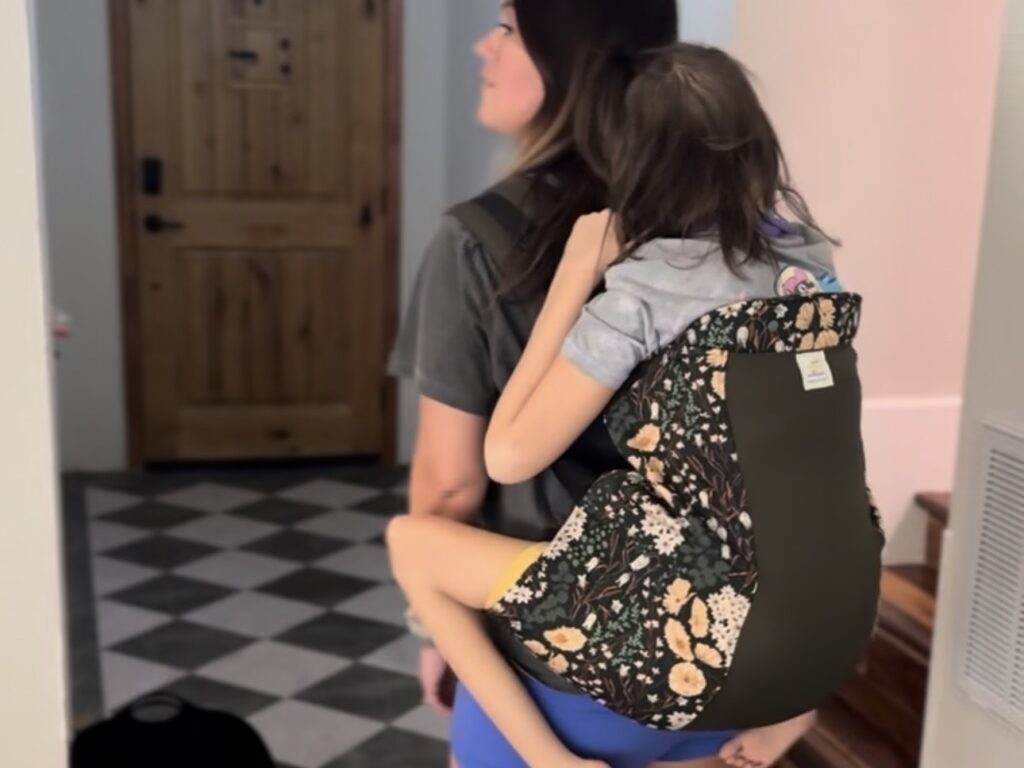
We do front and back carry in the MAX size. Front is perfect for when I’m alone on errands with her. Once you strap the carrier to yourself, you are just picking your child up like normal and then snapping the back clips into place.
Back carry is more comfortable when your kid gets heavier because the weight spreads across your shoulders and hips instead of pulling you forwards.
The tradeoff is that getting a bigger kid onto your back safely takes practice, and the first few times you’ll want another set of hands.
Car to carrier transfer, front carry demo
-> Watch the Full Babywearing playlist here
Getting Her In and Out
Getting a bigger child in and out of a carrier is a two-person process at first, and that’s normal. I practiced over my bed before I ever did it in public, with my husband standing behind me as a spotter.
Once I was comfortable with the movement on my own, I started doing it without help.
Most structured carriers support two or three carry positions: front carry, where the child faces in toward your chest; back carry, where the child rides on your back; and hip carry, where the child sits on your hip.
Not all carriers support all three, so check the product page before buying if carry position matters to your situation. Front carry is the most common starting point and the easiest to get into without help.
If something feels off that day, I don’t do it.
Other caregivers can use the same carrier, since the waistband and shoulder straps adjust enough to fit different body types. My husband, grandparents, and other people we trust can all put it on and carry her safely.
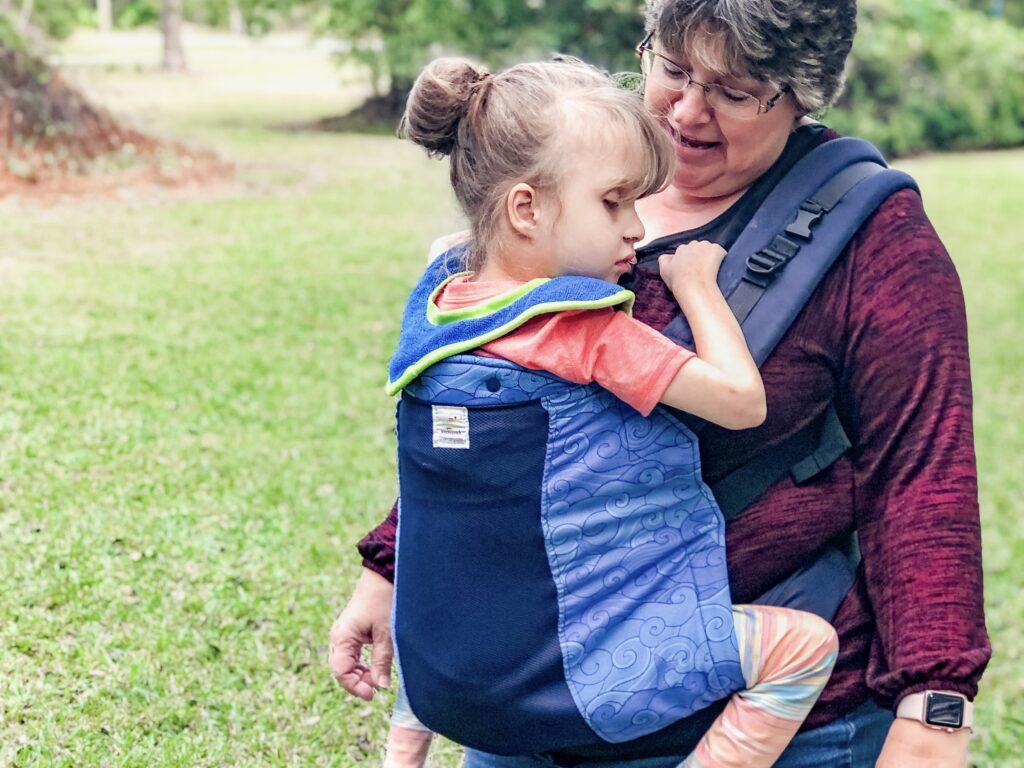
Other Mobility Options for Bigger Kids
Carriers cover the short carries. When we need more than that, we use other equipment.
If you’re at the point where your child is outgrowing standard strollers and you’re figuring out what comes next, I wrote a full guide on that.
Medical Strollers and Wagons for Bigger Kids
Do you babywear your big kid? What works for you?
Always check with your child’s medical team before introducing new equipment