
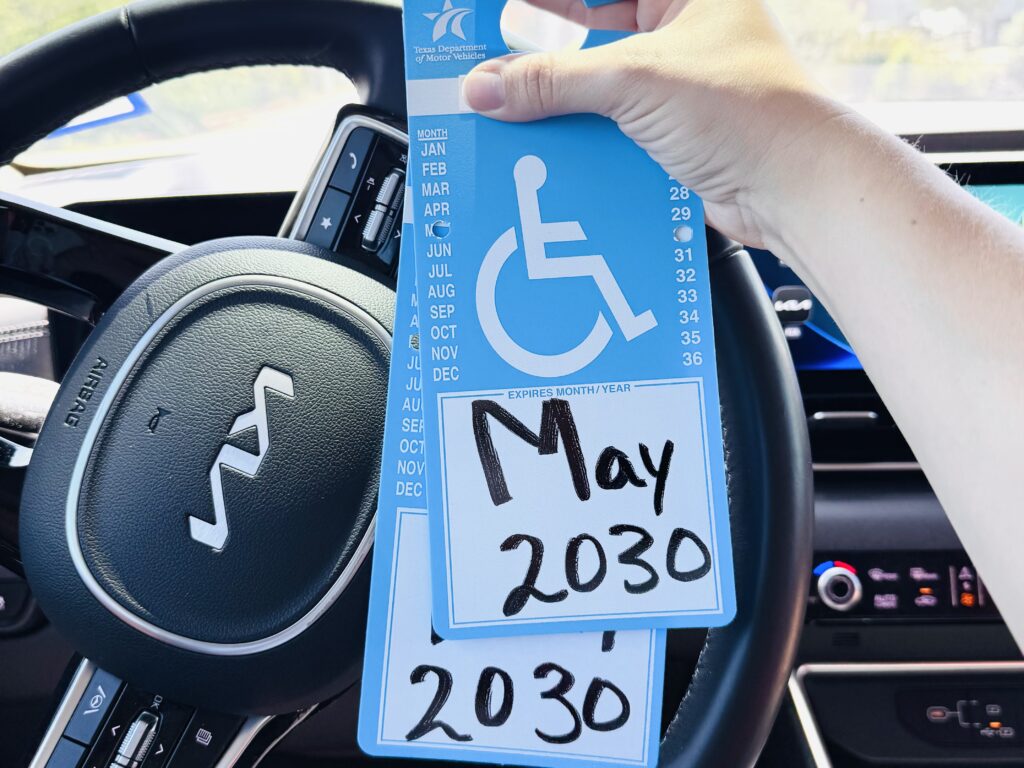
Getting a handicap placard in Texas is not just for adults. They are for anyone with a qualifying disability, including children. The handicap placard Texas issues for children, follows the same process as one issued for an adult.
My disabled daughter was seven years old before I knew a disability placard was an option for her. Her pediatricians never brought it up. I found it by accident, asked about it, and had the placard within a week.
Does My Child Qualify for a Handicap Placard in Texas?
Texas defines a qualifying mobility problem as one that substantially impairs a person’s ability to ambulate. Your child’s physician confirms which condition applies on page two of the application. Here is what the form lists:
- Cannot walk 200 feet without stopping to rest
- Cannot walk without the use of or assistance from a brace, cane, crutch, another person, or a prosthetic device
- Cannot ambulate without a wheelchair or similar device
- Has a lung disease where forced respiratory expiratory volume is less than one liter, or arterial oxygen tension is less than 60 millimeters of mercury on room air at rest
- Uses portable oxygen
- Has a cardiac condition classified as Class III or Class IV severity by American Heart Association standardsIs severely limited in the ability to walk due to an arthritic, neurological, or orthopedic condition
- Has a disorder of the foot that limits or impairs the ability to walk, in the opinion of a licensed physician
- Has another debilitating condition that, in the opinion of a licensed physician, limits or impairs the ability to walk
That last condition is the one that covers the widest range of diagnoses. If your child’s physician believes their condition limits or impairs their ability to walk or move safely, it belongs on the form. The handicap placard Texas issues has no age requirement anywhere in the definition.
Getting a Handicap Placard in Texas: Step by Step
The form you need is Form VTR-214, it is two-pages and available at txdmv.gov. (Some doctor’s offices will have them already printed out , but some require you to bring it in. Just in case, print it before you go to your appointment.)
- Download Form VTR-214 directly from TxDMV: https://www.txdmv.gov/sites/default/files/form_files/VTR-214.pdf
- Bring the form to your child’s doctor’s office. My child’s doctor filled out their section and handed it back the same day.
- Once the physician signs it, you take both pages to your county tax assessor-collector’s office (In Texas, it’s not the DMV who processes the application.)
- At the tax assessor’s office, you will receive a ticket at the receptionist desk and wait until your number is called to speak to someone who will process your application.
- You will need to fill out page one of the application your doctor signed
- Provide your ID and anyone else’s ID who will be transporting your child independently
- Choose the type of tag/placard combination you will need and select it on the application
- You will be told if you are missing anything before the application is finalized
- If you aren’t missing anything, you will be given the placards before you leave the office
TIP: Find your county’s location and hours at txdmv.gov before you go. Some locations have split hours so keep a lookout for that.
If You Have Two Caregivers Transporting Your Child Independently
On page one of the application, you will fill out your information, not your child’s, because you are the one applying as the person who transports them. Your driver’s license number goes on the application and that number will appear on the placard itself.
This means the placard is tied to you as the driver. Only you can use it when transporting your child.
If your spouse or another caregiver will also be driving your child independently, they need their own placard with their own license number on it.
Texas gives you the option to apply for two placards at once. If two people regularly transport your child in separate vehicles, choose the two placard option when you apply so each driver has one tied to their license.
Blue or Red: Which Placard Your Child Gets
The handicap placard Texas issues comes in two types. A blue placard is for a permanent disability. It is free, valid for four years, and renewed through the same county tax assessor-collector’s office.
A red placard is for a temporary disability. It costs $5 and is valid for six months from the date it is issued, or until the disability ends, whichever comes first.
Your physician marks which one applies on page two of the form. If your child has a permanent condition, you’ll get the blue one.
Disability License Plates are only issued for permanent disabilities.
How the Placard Is Issued and What Renewal Looks Like
Because I will be personally transporting my daughter and she does not have her own ID, the placard is issued under my driver’s license number, listed with c/o, and her initials.
In Texas, when you apply you choose one of four options:
- Disabled Person License Plate(s) with no Parking Placard
- One Parking Placard with no Disabled Person License Plate(s)
- Disabled Person License Plate(s) and one Parking Placard
- Two Parking Placards with no Disabled Person License Plate(s)
I have used different variations over the years depending on how many vehicles we were using and what made sense at the time. When I was moving between two cars, two placards worked because the placard travels with her to any vehicle she is riding in.
When we settled into one vehicle I switched to plates.
Right now I am going back to placards so I can have a specialty design plate on my current car. Which option you want is personal preference and it can change. You can go back to the tax office and modify it.
Modification
If your spouse, partner, or another regular caregiver needs to drive your child independently, they need their own placard issued under their license number.
To do that, you would surrender one of your two placards to the tax office, fill out the first page of the application again with the person’s information , with their photo ID, and the office will issue a new placard with his/her license number and your child’s initials.
Renewal
For a permanent disability, you do not need the physician to fill out the back of the application form again at renewal. Once that permanent disability is on file, it stays on file.
When my placard comes up for renewal, I go to the tax office, pick up a new form, fill out my information on the front, sign it, and that is it. No new prescription or doctor visit required.
Other Places To Use The Handicap Placard

In Texas, a disability placard, handicap placard or disability plate exempts you from fees at governmental unit meters and government-run parking facilities. It does not apply to private lots, but for city street meters and county-run garages, you are not paying.
There is also a refueling benefit. At gas stations that offer both full-service and self-service pump islands, displaying a placard or disability plate means you are entitled to refueling assistance.
If visiting Texas State Parks are part of your family’s routine, a disability designation can get you the Texas Parklands Passport disability pass. The documentation you need for that application is the same documentation that goes on VTR-214.
Don’t Wait For Your Pediatrician To Bring It Up
I saw two different pediatricians before we got the handicap placard the first time. Neither one said anything. When I finally asked, after finding something online that made me think it might apply to us, the answer came back immediately. She qualifies. Here is the form.
Ask for Form VTR-214 by name. Ask your child’s physician to complete the Disability Statement section. Then, take it to your county tax assessor-collector’s office. In Texas that office and the DMV are two different places, and the process does not go through the DMV.
FAQS about The Handicap Placard Texas Offers
My child doesn’t have an ID. How does the application work?
The handicap placard Texas issues is under your driver’s license number, listed as care of your child, with their initials. Your child does not need their own ID.
The physician paperwork verifies the disability. You provide your ID and your information on page one of the form.
My child can walk but cannot safely navigate a parking lot. Do we still qualify?
It’s likely, yes. Depending on the specific condition, a child who requires another person for assistance due to a mobility-impairing disability can qualify.
Ask your doctor directly to be sure.
My child has multiple diagnoses. Which one goes on the form?
Your child’s doctor only needs to confirm one qualifying condition. If your child has multiple diagnoses, they mark whichever applies on page two of VTR-214.
Can my spouse or another caregiver use the placard to drive my child without me?
Only if the placard is issued under their license number.
To set up a second placard for another driver, go back to the tax office with a photo of their ID, surrender one of your current placards, and they will issue a new one under that person’s license number in care of your child.
If the disability is permanent, no new physician paperwork is required
The Caregiver’s Medical Companion
If you are tracking diagnoses, physician notes, and medical records, this keeps it all organized in one place. The documentation that goes on VTR-214 starts with what you already have in your child’s file.
Very helpful to be able to park in the handicap spots as they are wider allowing room for wheelchairs, etc.
Great information, thank you for sharing! I wish doctors would think about such things.